
Living Inside the News: How Hypernormalization Hijacks Reality

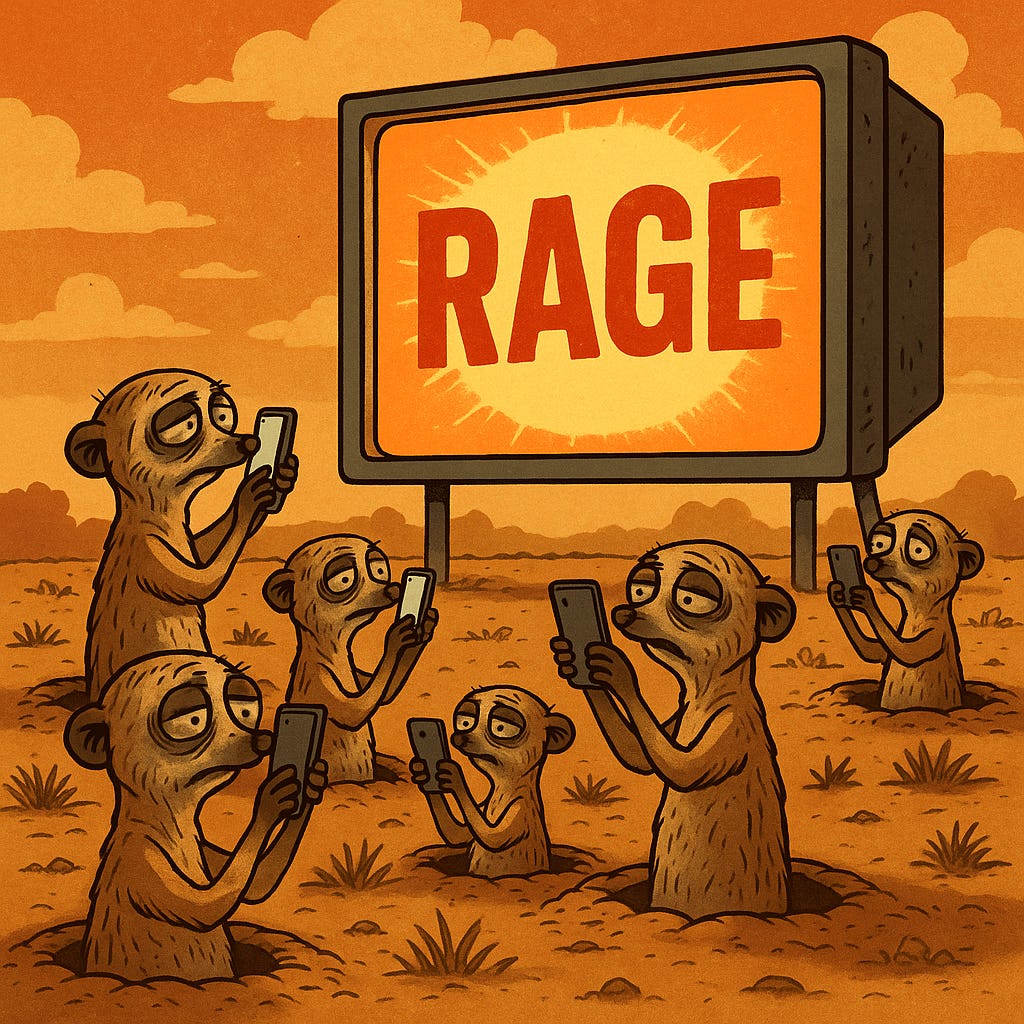
Oliver Burkeman in his book “Meditation for Mortals” captures something unnervingly familiar when he writes that people “started living inside the news… The news had become the psychological center of gravity in their lives—more real somehow than the world of their home, friends, and careers, to which they dropped in only sporadically before returning to the main event.”
This isn’t just a matter of spending too much time online. It’s something deeper and far more corrosive: the slow relocation of our sense of what counts as reality. The center of gravity moves from “reality reality”—our family, our work, our home, our dog snoring next to us—to a parallel informational universe that’s infinitely louder, more urgent, and ultimately more seductive than the real world.
People often dismiss this superficially: “Yeah yeah, everyone is on their phone too much.” But what’s really happening is closer to what filmmaker Adam Curtis famously called Hypernormalization: a condition where the world becomes so complex, chaotic, and difficult to interpret that we retreat into simplified, artificial narratives that feel more coherent than actual life. Over time, these narratives become more real than reality itself.
And once that shift happens, the psychological consequences get weird fast.
The Alternate Internet Worldview
The danger isn’t merely misinformation, or echo chambers, or the fact that everyone is yelling. It’s that online ecosystems—news feeds, social platforms, partisan channels, fringe forums—build a substitute world that has its own rules, its own heroes and villains, and most importantly, its own internal logic.
Stay inside this world long enough and you begin to experience a kind of epistemic vertigo:
your brain decides this is where the real action is.
Meanwhile, “reality reality” becomes a kind of side quest.
Friends, jobs, chores, community life—they all feel strangely muted, like background noise. People describe this disconnection eerily consistently:
“The physical world doesn’t matter as much anymore.”
“Everyone else seems deluded.”
“I feel like I’m the only one who really gets it.”
Hypernormalization thrives on this feeling. You’re no longer in the messy, uncertain, contradictory real world. You’re inside a curated storyline where everything is explained, everything fits, and everything is urgent.
It is intoxicating.
It is also a trap.
The NPC Problem
When someone gets absorbed into an Alternate Internet Reality, real-world relationships start to flatten. Other people cease to be full humans with perspectives and complexities and become what gamers would call NPCs—non-player characters.
NPCs aren’t people you converse with; they are obstacles or props that you ignore, or worse.
When you treat your family as NPC’s:
Dinner becomes “Did you see the video I sent you?” “Did you read my blog.”
Conversation becomes monologue.
Disagreement becomes proof of the other person’s blindness or hostility.
In a perverse inversion, the screen becomes intimate while the world becomes abstract.
The irony is that the real world has built-in self-correcting mechanisms. You might believe you mastered Russian literature by listening to The Brothers Karamazov under your pillow while you sleep, but when your Rus Lit exam asks:
“Analyze how the three brothers embody competing worldviews and whether a moral life requires integrating all three—”
you quickly realize you are, as the Russians say, in глубокая жопа.
Real life pushes back.
Alternate realities don’t.
When the Bubble Becomes a Bond
Things get even worse when multiple family members or friends share the same Alternate Internet Worldview. Not only do you have the algorithm validating your fears or beliefs, you now have each other. A feedback loop forms:
The online ecosystem amplifies the message.
Your real-life circle confirms it.
Opposing voices get filtered out or mocked.
Hypernormalization intensifies.
What is real becomes whatever everyone in your bubble agrees is real.
This is how we end up with families having two completely incompatible versions of the world living under the same roof.
Everything Is Urgent, Therefore Nothing Is
Online ecosystems are locked in a constant arms race for attention. The simplest way to grab someone’s mind is to tell them something is important, breaking, existential, catastrophic. So everything becomes a crisis.
If everything is urgent, nothing can be evaluated.
If everything is catastrophic, daily life feels trivial.
If everything is political, nothing can be shared.
There is no room for Ma, as the Japanese say. The necessary pause. The breath you need to take before speaking.
Hypernormalization feeds off this urgency and lack of space.
After enough time, your emotional life is tuned to the internet’s heartbeat instead of your own.
And that, my friend, is how people lose not just perspective but peace.
Escaping the Matrix (Withdrawal Included)
The first step out is absurdly simple and absurdly hard:
Stop feeding the machine.
You can’t reason your way out of Hypernormalization any more than you can talk your way out of alcoholism while still drinking. The algorithmic IV has to be removed.
People experience withdrawal. They sneak peeks. This is like switching to a smaller shotglass. Doesn’t work. Or, they substitute “just one YouTube channel” or “just one podcast with one more TV show or audio podcast” It’s like quitting scotch by switching to vodka: same drug, different flavor.
What rebuilds sanity is not argument—it’s contact with reality:
talking to real people,
doing physical tasks,
going outside,
listening to multiple perspectives,
engaging with things that don’t try to sell you a worldview.
Cults isolate for a reason.
Freedom requires de-isolating.
When you interact with ten different people in real life and none of them share the apocalyptic worldview you absorbed online, the spell begins to break.
What rebuilds sanity is Ma… Space and Time. Take time to think, reflect and feel before you you post or talk, or just turn to the next tweet or blogpost.
Slowly, your center of gravity shifts back.
Slowly, the real world feels real again.
Caring Selectively, Living Fully
This doesn’t mean we should stop caring about the world. It means we must choose very carefully which issues deserve a deep emotional investment—and even then, stay vigilant about losing perspective.
Reality matters more than the reality show.
People matter more than the feed.
And the antidote to Hypernormalization is not cynicism but reconnection.
Because once you’ve lived inside the news long enough, you forget that the real world is bigger, richer, quieter, more contradictory, and infinitely more healing than anything your screen can simulate.
And it’s waiting for you.